
06.10.2026
"It's a matter of desperation"
Alejandra Rodríguez Sánchez received her PhD in Sociology from Humboldt University of Berlin in 2022 and is currently a postdoctoral researcher at the University of Potsdam. She previously worked as a research associate at the German Centre for Migration and Integration Research (DeZIM) in Berlin, where she was the lead author of a study published in 'Nature' investigating whether non-governmental search and rescue operations encourage more migrants to cross the Mediterranean.
How did you come to work on the topic of search and rescue in the Mediterranean?
I started working at DeZIM, the German Center of Migration Integration Research, and they were looking for someone with statistical knowledge to work on this project.
There was a research question: is search and rescue in the Mediterranean a ‘pull factor’ or not? The pull factor claim says: if there are more search and rescue capacities, if more people are rescued, then more people will try to cross the Mediterranean, that's cause-and-effect. It’s a contentious topic, and DeZIM was interested in seeing what the state of the empirical causal evidence was.
There were already a few studies out there, but they weren't causal inference studies, rather investigating if there was a statistically significant correlation. Correlation doesn't really tell you why people cross, because there could be so many other things that increase arrivals: civil wars or economic crises at the same time that search and rescue capacities are increasing.
So what you were looking at was not just correlation, but rather what are the causes of people crossing, and is search and rescue potentially one of them?
Yes, that was one of those causes we were trying to isolate – or assumed causes.
The first thing I did was to try to understand the data landscape. So I looked at projects like the Missing Migrants Project. The thing that caught my attention was the number of deaths. It was not the focus of the study. But it became clear quite quickly that this was a major topic, even though the data on deaths is very incomplete. One of the accusations made against rescuers is that, if search and rescue is a pull factor, it could potentially also lead to more deaths, because more people are risking their lives.
Then we tried to understand other possible factors, including economic crises, conflict, and changes in working conditions in Europe, which is where most people crossing the Mediterranean are trying to go. We looked into some economic indicators that could be proxies for living conditions in Libya. Weather variables were also in the analysis.
The next step: which study design would answer the research question? I came across this idea of ‘predicting the counterfactual’. The counterfactual is what would have happened if something else didn't happen. In this case: if there hadn't been search and rescue NGOs, what would have the number of attempted crossings been?
Finally we were able to compare the prediction to the observed data, and that was our answer to the question of whether search and rescue has an effect or not.
How did you choose what time period to look at?
We went as far in the past as possible, which was 2011, just to have a longer time series, so the model could learn a little bit more about the patterns in the data. The peak of the crossings was around 2014, 2015. And we went as far forward as possible too, which was 2020. Then we broke it down into different periods: Operation Mare Nostrum; search and rescue by NGOs; and the start of the Libyan Coast Guard activity in the area around early 2017.
We didn't see any evidence of search and rescue having had any impact on attempted crossings
What were the findings, and were there any that surprised you?
The first result that surprised us: we didn't see any evidence of search and rescue having had any impact on attempted crossings. But once we also included the Libyan Coast Guard in that period, that actually that did have an impact.
It was a policy change, the extension of the Libyan search and rescue area and the European Union increasing the budget of the Coast Guard. This led to a decrease in the number of attempted crossings. That was clear from the data. It makes sense that fewer people would cross if they're paying smugglers and then being forced back and incarcerated anyway.
When you looked at Operation Mare Nostrum, did you find there was an impact?
Also no. That had no impact.
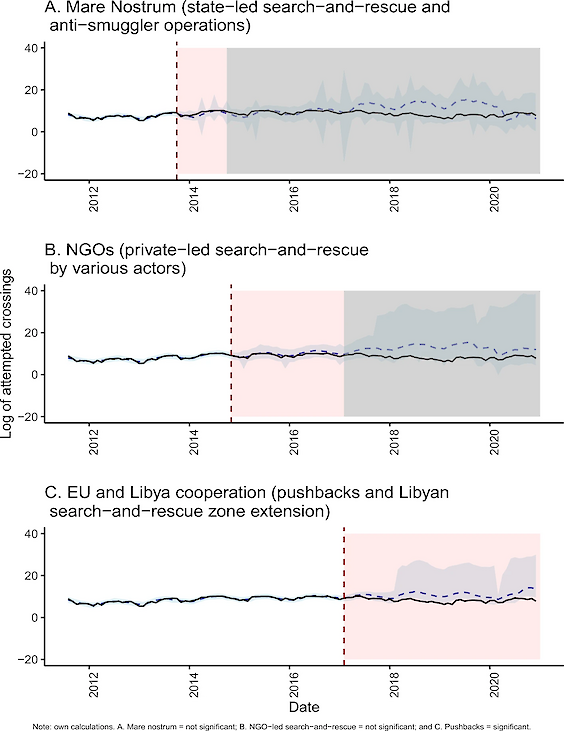
That's interesting: so when there was briefly a state search and rescue program in the central Mediterranean, it didn't encourage more people to cross.
No, and I think that's why it was important to consider the number of conflicts, and their intensity in Libya, in Syria. Conflict was the thing pushing people to leave, or try to leave, as soon as possible: if you adjust for that, the model predicts there are going to be more people coming.
Most of them are refugees or are looking for refugee status.They don't have any other way of coming to Europe.
If you offer people safe opportunities to travel, then no one's going to risk their life in a small boat
Are there any policy suggestions based on your paper that policymakers could or should implement?
It's known from other studies on legal pathways that if you offer people safe opportunities to travel, then no one's going to risk their life in a small boat. So if you want to stop that, just create those pathways: for example, a temporary visa, work permits. Because people are making a decision whether or not to take this obviously very risky journey, for reasons that are not always known to us. If you change the terms of that decision, it would also change the numbers of attempted crossings.
And what your study has shown is that the presence of NGOs is not a factor in that decision.
Yes.
There's some data in the US context that shows, in some periods where more legal permits were offered, fewer irregular crossings happened.
But it hasn't been really tested anywhere else because most migration policy in terms of visas has become tougher and tougher to the point where it's impossible to get even a visa appointment in many countries. So if you don't have any other way of coming, then crossing the sea is a last resort.
This question of the pull factor is still one of the biggest critiques that we see on social media, from politicians, in legacy media. But actually, studies like yours and those before suggest very strongly that is not the case. Do you have a reason for why this myth of the pull factor is still so prominent?
This paper was my first contact with the topic of irregular migration from a scientific perspective. I felt the debate was so focused on Europe. It was all about the benefits that refugees receive: they must be coming because of us or because of our money, and that's it. But if you put the debate into focus, then you realise Europe is actually not receiving the majority of refugees. In comparison to the amount of resources Europe possesses, it's quite a small fraction in terms of population. A place that doesn't offer much in terms of benefits, like Turkey or Lebanon, has far more refugees than somewhere like Germany.
One of the things I thought when I started this study, was: there's no way this can be an effect, because many of these people have crossed the Sahara Desert, which is much bigger than the Mediterranean, and very dangerous. After doing that, whatever is driving them – even if we don't always know what it is – is much stronger than whether there's a search and rescue ship or not.
Many of these people have crossed the Sahara Desert, which is much bigger than the Mediterranean, and very dangerous. After doing that, whatever is driving them [...] is much stronger than whether there's a search and rescue ship or not.
The presence of search and rescue can have important benefits, like saving the lives of those who are shipwrecked. But as a factor in why people cross, it doesn't really make sense. What I kept thinking about as an analogy was: do people take risks, like driving drunk or smoking, just because they think there’ll be an ambulance to rescue them, or medical treatment to help them? It's ridiculous, right? That's not how people work. Because you might die anyway. Maybe the hospital is full or busy. And with search and rescue NGOs, there's also a high chance that you're not going to get rescued or even found.
Actually, one study in Western Africa asked prospective migrants whether they knew the risk of dying, to inform them of the risk in case that would change their decision. They found that people think the risks are even higher than they really are, but they still want to go. People do dangerous things. There's no way I can fully understand why someone would go on a boat. Maybe if I ever have to do it, I will understand. It's a matter of desperation. That's something people in Europe have a really hard time understanding because we live in this bubble, we don't see that despair on a day-to-day basis.
